

Stranger Things Season 4
Props And Environments
This show holds a special place in my heart. It’s the last show I was a Matchmove artist and began my transition towards being a 3D Modeller full time.
I worked on multiple episodes within the 4th season, progressing from proxy geo used for particle collision to aiding my fellow matchmove/layout artists and set projections. To my first proper asset. The inhibitor Chip!

Inhibitor Chip
A typical treatment for a VFX shot is additional blood, be it from the practical FX not giving the desired effect, notes made after the shoot finished or simply due to physical limitations.
Instances such as this require a realistic replica to be modelled. Even if most of the object is obscured with additional FX, light will still need to react accordingly with its real-life counterpart.
Proxy Geo Shots

Nancy’s Room - Bed and vines
Proxy geo in shots like this mainly benefits departments such as Matchmove, Layout and FX. While LIDAR can be provided on such shows, it can become somewhat troublesome since a section of a set can be a rather heavy piece of geometry. I’m talking about a poly count of over one million faces, easily!
This can slow down everyone’s machines to a grinding halt and leave many artists rather frustrated…
So, from a matchmove and layout perspective, proxy geo can be an excellent alternative for lineup purposes and QC camera tracks since you can control the density of the mesh.
In sequences that involve particle FXs or have actors interacting with particular objects, proxy geo can work as both a reference point when using Digi-Doubles (CG rigs of actors/actresses) in world space and as a blocker to prevent FX particles from intersecting.
Depending on what’s happening in the shot will determine if the model needs to be accurate based on its overall silhouette vs a one-to-one replica. This is usually based on the proximity of what’s interacting with it.
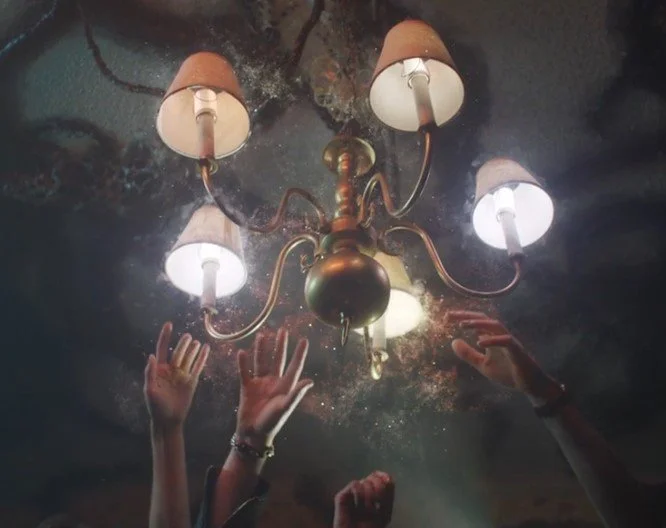
Chandelier
It’s not uncommon for framing to change on a shot as the show hits post-production. So, in instances like this, a workaround is utilising proxy geo to extend the set!
Depending on the use case, if the camera is far away. Something like a set projection (projecting the texture of the set through a camera onto geometry) would be sufficient to sell the feel of an extended environment when the practical set no longer fits the framing. If it’s up close, on the other hand, chances are the textures will need to be rebuilt through traditional methods unless there’s an equivalent close-up shot.

Swimming Pool
What’s Proxy Geo?
Proxy geo is low-resolution geometry that can be used as a pipeline-friendly alternative for a heavier mesh across multiple departments.
Its range of uses can include:
Low-res alternative for LIDAR to aid camera tracking, match anim/rotoanim or layout tasks.
Clean mesh for set projections (projecting textures for set extensions)
Particle collision for FX
Low-res geo for riggers, animators and lighting artists
When no LIDAR hasn’t been provided by the client and a 3D representation of a set or object is required