What Is a Props and Environment Artist? (And How Do You Become One?)
If you've spent any time browsing 3D job boards or credits lists, you've probably seen the title "Props and Environment Artist" and wondered exactly what it means — and how it's different from character modelling, or concept art, or any of the dozen other 3D job titles floating around.
Here's the honest breakdown.
What Is a Props and Environment Artist?
A Props and Environment Artist is a 3D artist responsible for creating any CGI object in a film, TV show, or game that isn't a character.
That covers a lot of ground. Some examples of what falls under this role:
Set props
Hero assets (the ones that get a close-up)
Architecture
Buildings
Vehicles
Vegetation
Grey boxing (rough placeholder geometry used early in a project)
Set assembly
What Does the Day-to-Day Actually Look Like?
Tasks vary daily, and they shift depending on where a show is in production. Most of the time, you'll be assigned an asset to take from start to finish. That generally means:
Block pass — rough shapes, getting the proportions and silhouette right
1st pass — building out real geometry and detail
Detail pass — refining edges, adding wear, tightening everything up
Quality check — making sure it's ready to hand off to the next artist in the pipeline (texturing, lighting, rigging, wherever it goes next)
Here's a real example from one of my own props — an axe, taken from block pass through to a finished, lit render:
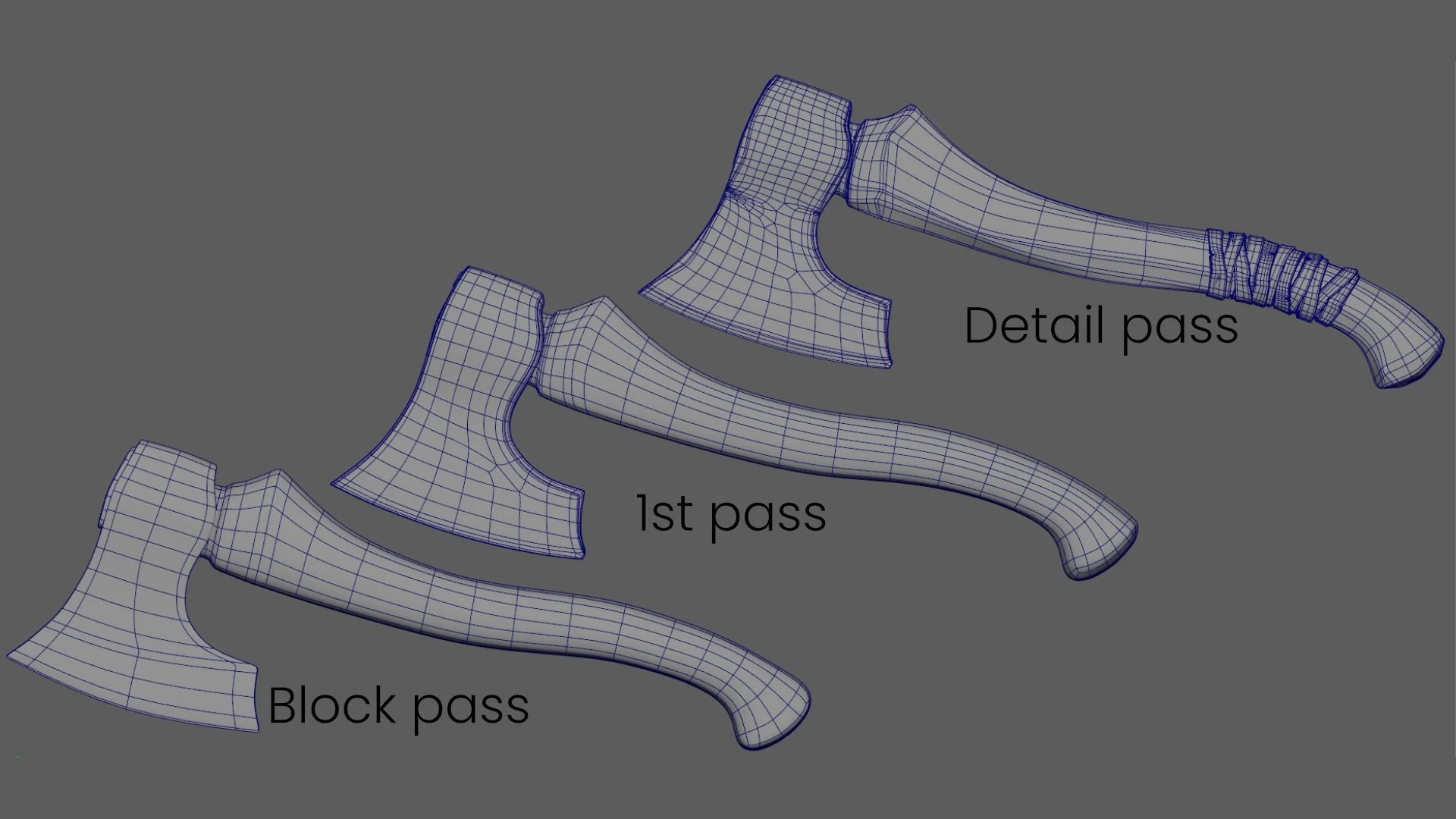
Modelling Progression / Stages

Final Render in Arnold
Along with building assets start to finish, there are also stretches of a project where you're focused on just one part of the process across many assets at once. Think re-organising UV shells, correcting technical issues like N-gons or flipped face normals, or populating an entire set with the same prop repeated hundreds of times.
(That last one may or may not be based on a true story.)
Is This the Right Path for You?
If you like the idea of building the world rather than the character standing in it — if you'd rather nail the weight of a weapon, the texture of an old building, or the believability of an overgrown ruin — Props and Environment work might be exactly where your interest naturally sits.
It's also one of the more in-demand specialisations in film and TV, precisely because there's so much of it in any given production. Every show needs dozens, sometimes hundreds, of props and environment pieces — and there's a real gap between what most people learn from scattered online tutorials and what studios actually expect from a working artist.
Where to Go From Here
Tutorials can teach you how to model one specific thing. They're much less good at teaching you the underlying principles that let you confidently approach anything — a weapon you've never modelled before, a building style you haven't tackled, a reference photo with no clean angles.
That's the gap 1-on-1 mentorship is built to close. Rather than hunting down a new tutorial every time you hit something unfamiliar, mentorship works on the fundamentals that transfer across every asset you'll ever build — so you stop relying on someone else's step-by-step and start solving problems independently, the way a working props artist has to.
If that's where you're at — comfortable with the basics, but ready to build real confidence — book a 1-on-1 mentorship session and let's work on it together.